

Waioha and Kuilei Place
November 2022's report features Waioha in Koa Ridge & Kuilei Place.

Updated November 2026.
Hawaii has the highest cost of living in the United States. In the second quarter of 2026, the state scored 185.8 on the Missouri Economic Research and Information Center’s cost-of-living index, where 100 is the national average. Housing and electricity drive most of that gap, but nearly everything costs more once it has crossed the Pacific.
Here is what that looks like in prices you already know, plus the costs most people don’t plan for until they live here.
| Cost | Hawaii | U.S. |
| Overall cost-of-living index | 185.8 | 100 |
| Housing index | 302.6 | 100 |
| Utilities index | 207.3 | 100 |
| Groceries index | 135.8 | 100 |
| Electricity, per kWh | 47.2¢ | 18.2¢ |
| Gas, per gallon | $5.54 (Honolulu) | $4.41 |
| Median single-family home, Oʻahu | $1,110,000 | — |
| Living wage, one adult, Honolulu | $64,134 a year | — |
Sources: MERIC, Q2 2026; U.S. Energy Information Administration, August 2026; AAA, October 1, 2026; Honolulu Board of Realtors, September 2026; MIT Living Wage Calculator, February 2026.
Price per gallon understates the difference. What you notice is the total at the pump.
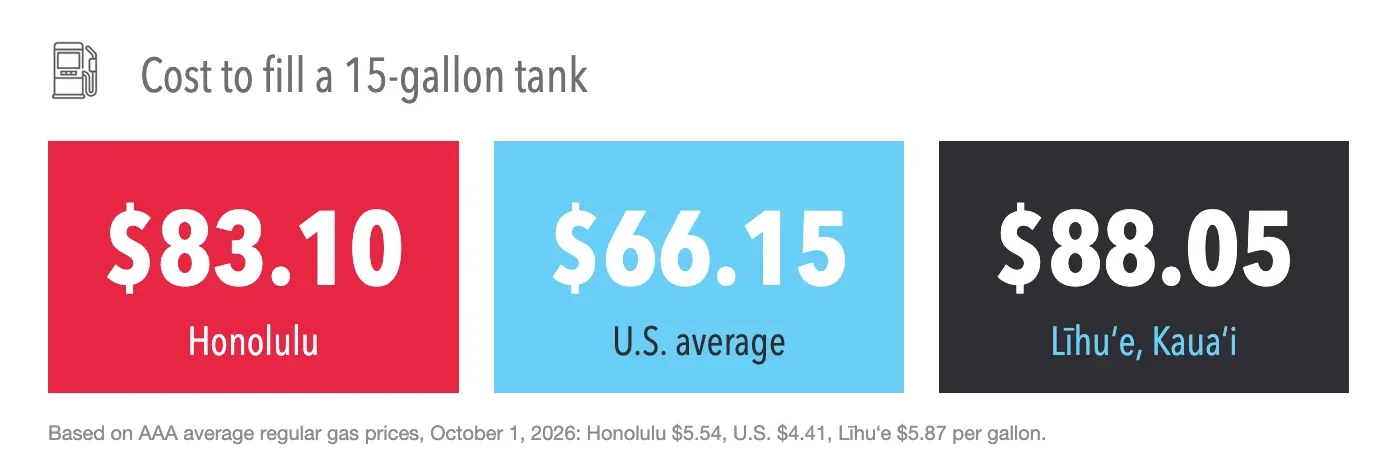
| Fill-up | Honolulu ($5.54/gal) | U.S. average ($4.41/gal) | Difference |
| Sedan, 15-gallon tank | $83.10 | $66.15 | +$16.95 |
| Pickup, 26-gallon tank | $144.04 | $114.66 | +$29.38 |
Fill a pickup once a week and that difference adds up to about $1,500 a year. Gas costs more on the neighbor islands: $5.69 in Hilo, $5.71 in Kahului and $5.87 in Līhuʻe, according to AAA’s October 1, 2026 report.
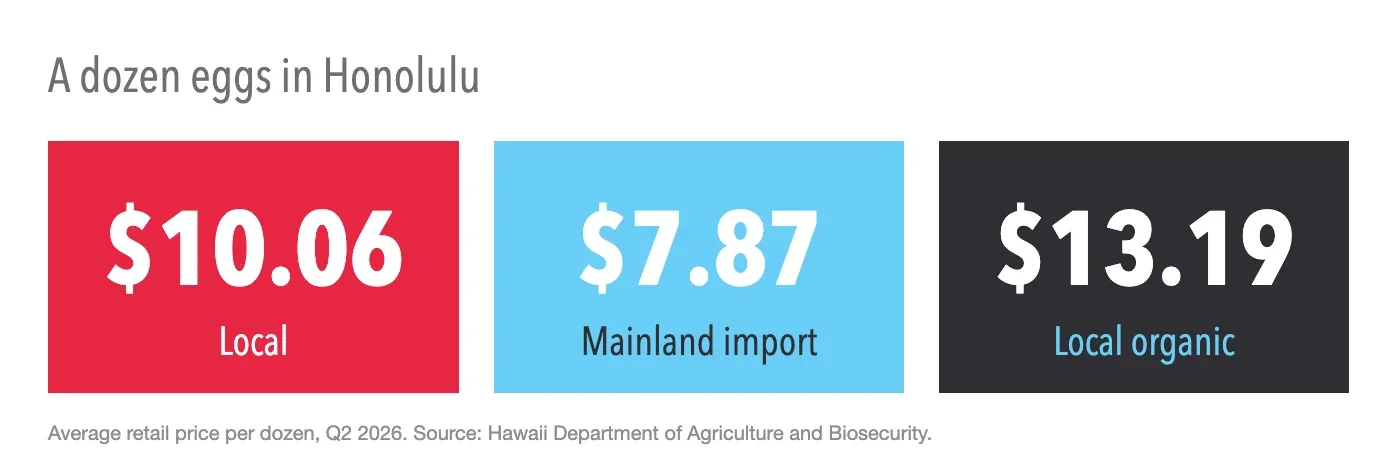
In the second quarter of 2026, a dozen conventional eggs averaged $10.06 in Honolulu stores if they were laid in Hawaii, and $7.87 if they were shipped from the mainland, according to the state Department of Agriculture and Biosecurity. Local organic eggs averaged $13.19.
That gap surprises people: the local option costs more, not less. We explain why below.
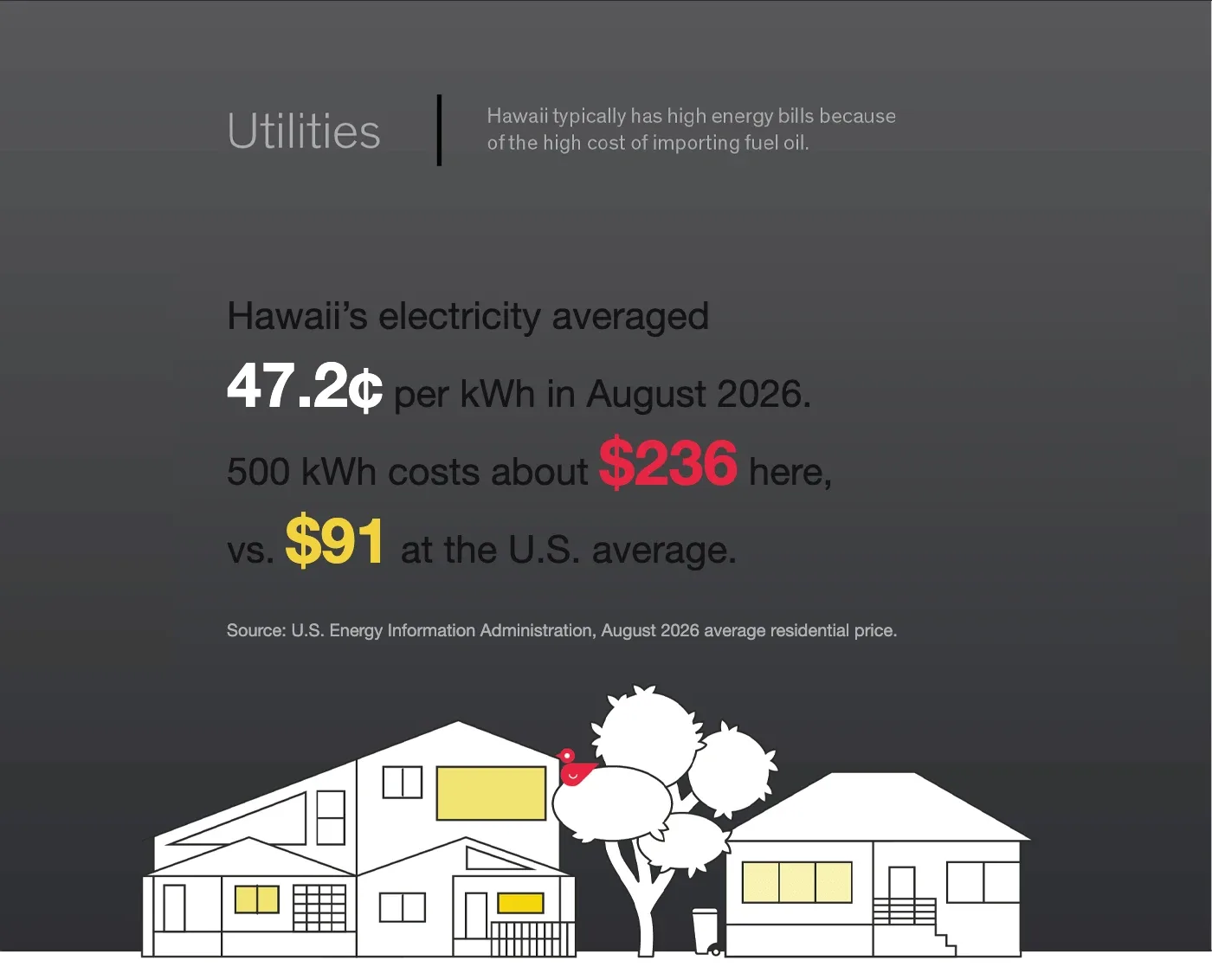
Hawaii’s residential electricity averaged 47.2 cents per kilowatt-hour in August 2026, more than 2.5 times the national average of 18.2 cents. At those prices, 500 kWh a month, a modest amount for a household running air conditioning, costs about $236 in Hawaii and about $91 at the national average.
Most of Hawaii’s power still comes from imported oil, and Hawaiian Electric passes fuel costs through to customers. When oil prices jumped in early 2026, the utility warned that typical bills would rise 20% to 30%. A typical Oʻahu bill was $196.43 for 500 kWh in March, before those increases. Because the bill moves with the global oil market, budget for swings, not a fixed number.
That is why rooftop solar is so common here. It is also why a home’s orientation, shade, insulation and ceiling fans matter more in Hawaii than in most places.
Hawaii’s insurance market has tightened sharply since the 2023 Maui wildfires. Statewide homeowners rates rose 32% to 54% in a year, according to state data reported by Hawaii News Now, and nonrenewals rose nearly 216% from 2018 to 2023.
The biggest factor for many buyers is construction type. Many older Hawaii homes are single-wall construction: one layer of vertical boards with no separate interior wall. Since 2025, several insurers have pulled back:
Hurricane coverage is usually separate from a standard homeowners policy in Hawaii. Before you make an offer on an older home, get an insurance quote, including hurricane coverage, during your due diligence period. A home that looks affordable can carry an insurance bill that changes the math.
Buying an older home?
Ask for the year built, the wall construction, the roof age and any electrical upgrades. Send those details to an insurance agent before your inspection contingency ends, not after closing.
Most of what Hawaii consumes arrives by container ship, and two carriers, Matson and Pasha, handle most of that cargo. Freight, port handling, warehousing and inter-island shipping all end up in the shelf price. Bulky, heavy items carry the most freight relative to their value, which is why appliances, furniture, building materials and cars feel especially expensive here.
Economists disagree about how much of that cost comes from the Jones Act, the federal law requiring U.S.-built, U.S.-crewed ships between U.S. ports. A 2020 study commissioned by the Grassroot Institute of Hawaii estimated the law costs Hawaii residents about $1.2 billion a year. A study funded by the maritime industry found no effect on the cost of living. Either way, distance and scale mean shipping costs are not going away.
Buying local supports Hawaii farms and ranches, but it rarely saves money. Local producers pay Hawaii prices for land, labor, electricity and water. Much of their feed, fertilizer, equipment and packaging is shipped in too, and they produce at a far smaller scale than mainland operations. The egg prices above show the result: local is fresher, but imported is often cheaper.
Housing is the largest gap between Hawaii and the mainland. Hawaii’s housing index of 302.6 means housing costs about three times the national average.
| Island | Median single-family home | Median condo |
| Oʻahu | $1,242,500 | $528,000 |
| Maui | $1,356,975 | $625,000 |
| Kauaʻi | $1,600,000 | $999,000 |
| Hawaiʻi Island | $599,000 | $547,500 |
June 2026 medians from each island’s Board of Realtors, compiled by Title Guaranty. Monthly medians swing; Oʻahu’s single-family median was $1,110,000 in September 2026.
Renting is the usual first step for newcomers. HUD’s 2026 fair market rents for Honolulu County are about $1,975 for a one-bedroom, $2,450 for a two-bedroom and $3,325 for a three-bedroom. Condo buyers should also budget for monthly association fees, which can add hundreds of dollars and are a large part of the true cost of a condo.
If you’re weighing islands, see our guide to which Hawaiian island to live on. If you’re considering building, see what it costs to build a home in Hawaii.
| Tax | 2026 rate |
| State income tax | 1.4% to 11%; the top rate applies above $200,000 of taxable income for single filers |
| General excise tax (GET) | 4%, or 4.5% on Oʻahu; applies to most goods and services, including groceries and rent |
| Honolulu property tax, owner-occupied | $3.50 per $1,000 of net taxable value |
| Honolulu property tax, non-owner-occupied (Residential A) | $4.00 per $1,000 up to $1 million; $11.40 per $1,000 above |
Income tax is high, but property tax is among the lowest in the country. An owner-occupied Oʻahu home assessed at $1.1 million pays roughly $3,850 a year before the homeowner exemption lowers its taxable value. See how Oʻahu property taxes work.
The GET is easy to miss. Unlike most states’ sales tax, it applies to groceries, medical services and rent, so it touches nearly every line of a household budget.
Hawaii does not tax Social Security benefits or most public pensions, which is part of its appeal for retirees.
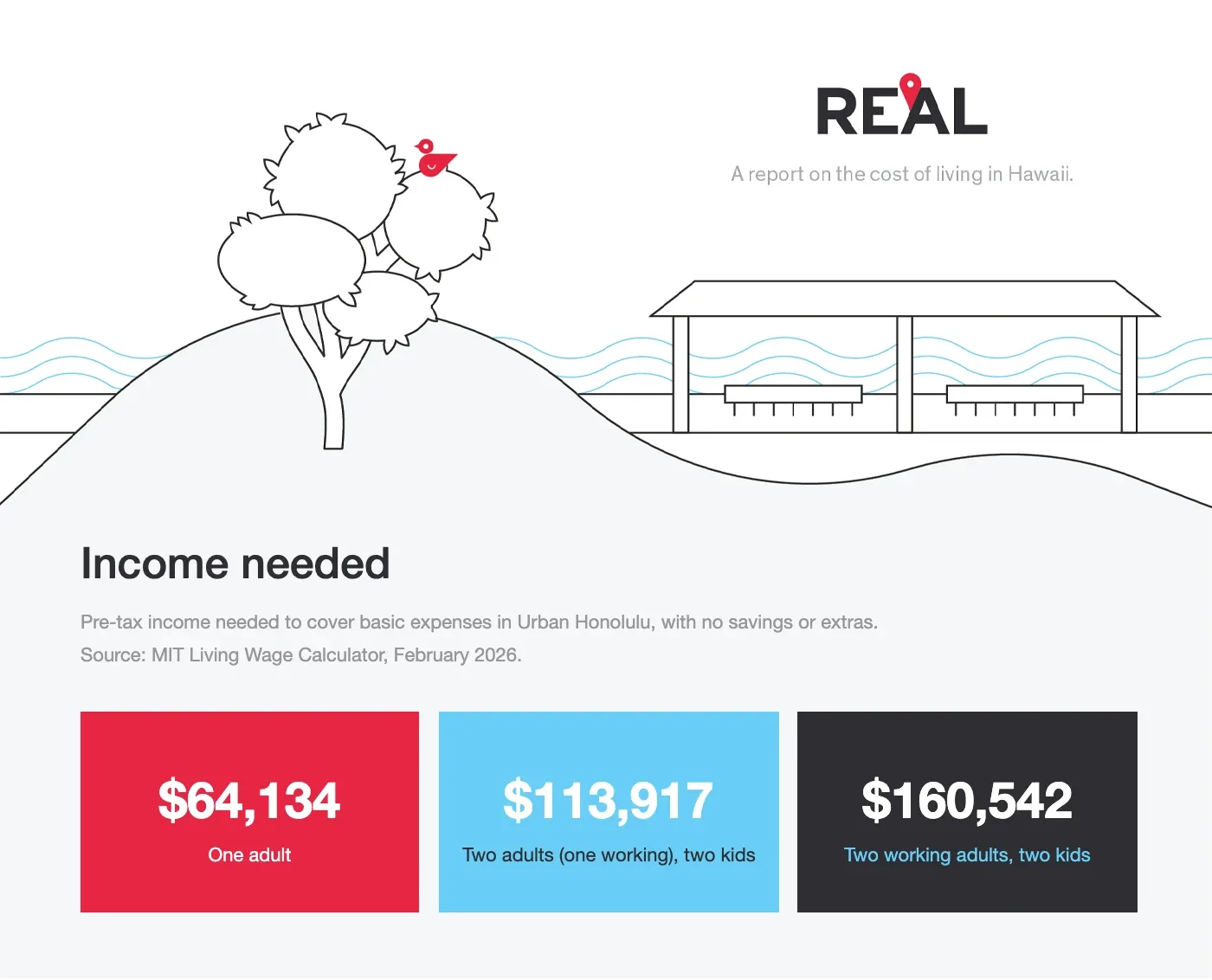
The MIT Living Wage Calculator estimates the pre-tax income needed to cover basic expenses in Urban Honolulu, with no savings or extras:
| Household | Annual income needed |
| One adult, no children | $64,134 |
| Two adults (one working), two children | $113,917 |
| Two working adults, two children | $160,542 |
A living wage covers the basics. Buying a home, saving for retirement and traveling to see family on the mainland all require more.
Hawaii costs more, and that won’t change. Knowing where the money actually goes makes the decision easier. If you’re planning a move, start with our guide to moving to Hawaii.
November 2022's report features Waioha in Koa Ridge & Kuilei Place.
November's report recaps Kaulu and shares what's happening next.
A potential solution for Hawaii's housing shortage problem.
Learn the ins and outs of buying land in Hawaii.
October 2022's report features Pulelehua on the island of Maui.
Calculate your property taxes before your next purchase.


